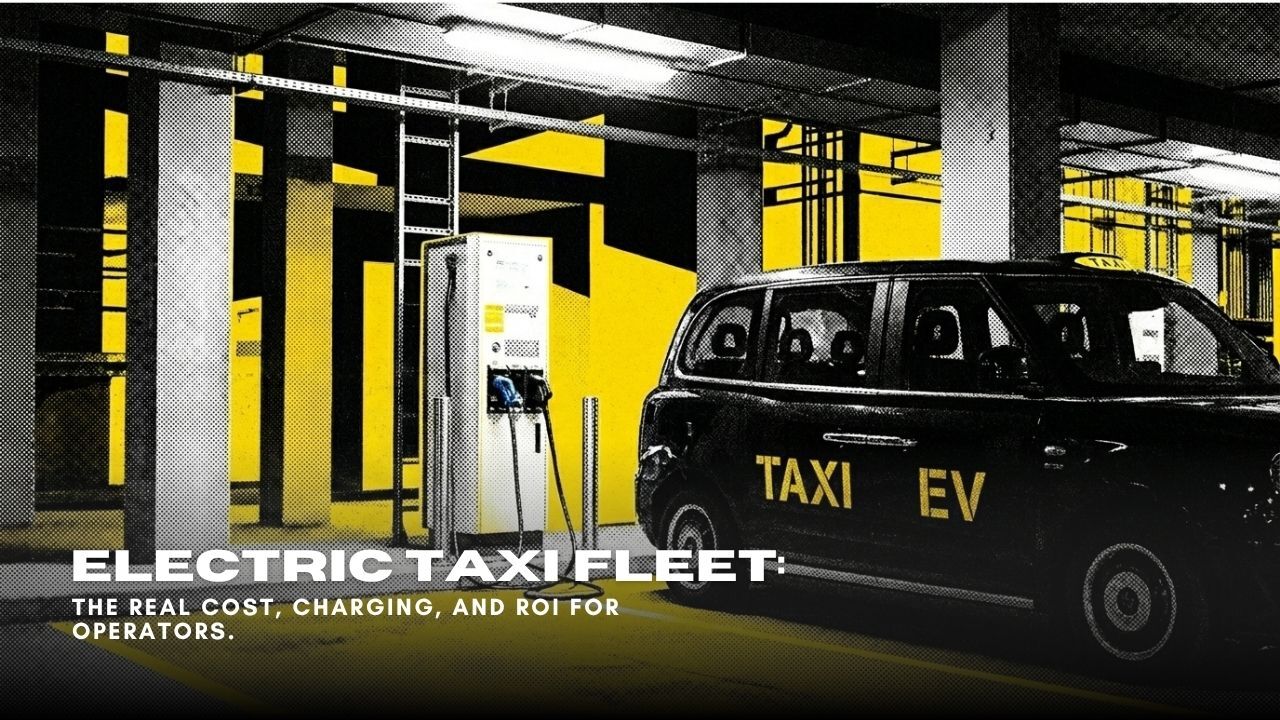
A London black-cab driver did the math last year and switched his electric taxi back to running on petrol.
Not because he hated the car. Because charging it had quietly become more expensive than fuelling a hybrid.
Public rapid charging in his city jumped around 50% in twelve months. An 80% home charge cost roughly half the price of the same charge at a rapid point. And on bad days he lost two hours queuing for a charger, time he could not earn a penny while he sat still (BBC News).
So here is the uncomfortable truth most EV taxi content skips. An electric taxi can cost more than petrol. It depends entirely on how you charge it and how hard you run it.
If you run a fleet of 30 to 150 private-hire vehicles, this is the operator-grade version of that decision. Real cost per mile. A real total cost of ownership picture. The charging call that decides whether you save money or lose it. Payback math at taxi mileage, not private-driver mileage. And the 2026 rule changes that just rewrote the spreadsheet.
An Electric Taxi Can Cost More Than Petrol. Here Is When.
First, the term everything in this guide hangs on. Total cost of ownership, or TCO, is every cost of running a vehicle across its life. Purchase price, energy, maintenance, insurance, depreciation, financing. Not just the number on the windscreen.
Most EV-versus-petrol content compares the showroom price and the fuel price. That is not the decision you are making. You are making a TCO decision across hundreds of thousands of high-mileage miles.
And on TCO, an EV taxi loses in two situations. The first is when you have no depot and live off public rapid charging. The second is when your cars sit idle too much, so the per-mile savings never rack up enough miles to add up to anything.
Going electric is not a vehicle-purchase decision. It is a charging-and-utilization decision. Buy the right car, charge it the wrong way, and you lose money on a vehicle that was supposed to save it.
Keep that one line in your head. The numbers below are just the proof of it.
What an Electric Taxi Fleet Actually Costs to Run
Strip out the noise and a running EV has three cost stories: energy, maintenance, and the full TCO picture that the headlines get wrong. Let us take them in order.
Energy per mile
This is where the savings live, and the exact figure depends on your market, so I will flag each one. For US operators: a driver charging at home in 2025 pays roughly 4 to 6 cents per mile in energy, against about 10 to 13 cents for a comparable petrol car (Recharged, Nov 2025).
For UK operators, the gap is wider still. Electric cars cost around 65% less per mile to run than petrol, roughly 7p against 19 to 21p (The Electric Car Scheme). A UK taxi-trade breakdown puts it sharper still: home charging as low as 3p per mile against about 19p for combustion, with on-street chargers around 14p and a 25% rapid-charge discount for e-taxis (Brighton & Hove City Council).
Real driver, real receipts: a prolific electric rideshare driver spent about 5 dollars a day on electricity against roughly 18 dollars for the petrol equivalent (Bloomberg, via The EVolution). A 13-dollar daily gap is over 3,000 dollars a year, per car, on energy alone.
Maintenance
This one is structural, not a tariff you can lose overnight. An EV has roughly 20 moving parts. A combustion car has about 200 (Brighton & Hove City Council). No oil changes, no exhaust, far less brake wear thanks to regenerative braking.
The result is 31 to 50% less maintenance than a combustion car. And on fuel, the same source puts an EV at about 675 dollars a year against roughly 2,220 dollars for petrol at 15,000 miles (MOTORWATT, Jul 2025). For a high-mileage taxi, both gaps multiply with every mile.
The full TCO picture, and why the headlines are not about you
Here is the data point that scares operators. AAA's 2025 analysis found that across three of four vehicle types, new EVs cost more to drive than petrol or hybrid cars once you add purchase price, insurance, depreciation, and financing. A medium-sedan EV came out at about 91 cents per mile against roughly 66 cents for petrol (AAA, via AOL).
Read that and you would never electrify. So read the fine print. AAA models 15,000 miles a year. A taxi runs two to four times that.
That single fact flips the whole conclusion. High mileage is exactly what pushes TCO toward EVs. The per-mile energy and maintenance savings compound with every mile, while the fixed costs, the purchase price, the financing, the insurance, spread thinner across far more miles. The headlines that say EVs are expensive are describing a private driver doing the school run. They are not describing your fleet.
AAA's 91 cents per mile is real. It is also modelled at 15,000 miles a year. Run that same EV at 45,000 taxi miles and the math inverts, because the cheap part scales up and the expensive part gets diluted.
Now the worked example, because round-number hand-waving is what got operators burned in the first place.
Take one vehicle. 40,000 miles a year, normal for a busy private-hire car. Charge it at your depot at around 5 cents a mile and energy costs you about 2,000 dollars for the year. Run the petrol equivalent at around 12 cents a mile and you pay about 4,800 dollars. That is a 2,800-dollar swing on energy alone, before maintenance, where the EV saves you more again.
Now flip the charging. Put that same car on public rapid charging at two to three times the depot rate, and that 2,800-dollar saving shrinks, vanishes, or goes negative. Same car. Same mileage. Opposite outcome. The variable is not the vehicle. It is the plug.
Want this run for your own fleet size, mileage, and local electricity price instead of a worked example? That is exactly the kind of model you can build inside FleetFlow before you commit a single vehicle.
Charging: The Decision That Makes or Breaks ROI
If you only read one section of this guide, read this one. Everything else is decided here.
Depot AC charging versus public DC rapid
AC charging is slower, cheaper, and made for vehicles that sit still overnight. That is your depot. DC fast charging is quick and useful for a mid-shift top-up, but it costs more per kWh and the hardware is a different universe of money (Rizon Truck).
The hardware spread is wide. Level 2 chargers start around 400 dollars. DC fast chargers run from roughly 18,000 dollars to 350,000 dollars and more per port, plus installation (Qmerit, Aug 2025). So your charging strategy is also a capex decision, not only an energy decision.
And there is a cost most operators never see coming. A demand charge is what your utility bills you for your single highest burst of power draw in a month, not just the total energy you used. Plug a row of fast chargers in at the same moment and you spike that peak. Demand charges can be 30 to 50% of a depot's electricity bill (Clean Fleet Report).
The depot bill is not just kWh times price. Charge ten cars at once at full power and the demand charge alone can be a third to a half of the invoice. When you charge matters as much as how much you charge.
The scheduling lever, where software earns its keep
This is the single most important number in this entire guide.
Researchers studied nearly 20,000 EVs in Shenzhen's all-electric taxi fleet and found that optimizing charge timing matters more than charger location. Better real-time queue information and flexible shift-change charging cut downtime by over 30 minutes per vehicle per day. Using breaks and nighttime to charge cut downtime by over an hour a day, and reduced revenue losses from charging by roughly 90% (UC Berkeley ITS).
Read that again. The win was not more chargers or better-located chargers. The win was charging at the right time. That is a scheduling problem. And a scheduling problem is a software problem.
This is the whole reason a fleet platform belongs in an EV cost conversation. The theoretical TCO advantage we just walked through only becomes real money when something tracks state of charge across the fleet, slots charging into shift gaps, and keeps cars on paid trips instead of parked at a plug. The savings are operational, not infrastructural.
How Long Until It Pays Back?
Every operator wants one number. Anybody who gives you one is guessing. Payback is not a number you can copy from a blog. It is a function of four levers.
- Annual mileage – The biggest lever. More miles means the per-mile savings compound faster and the purchase premium dilutes faster. High mileage is the friend of EV payback.
- Charging mix – The share of energy you take from cheap depot AC versus expensive public DC. Shift this one wrong and you can erase the saving the mileage created.
- Utilization – Paid miles versus idle and charging time. A car earning while it could be charging, or charging when it should be earning, lengthens payback on both ends.
- Incentives – What your market still offers after the 2025 to 2026 cuts. Treat these as a bonus that shortens payback, not the thing the business case stands on.
So do not chase a single payback figure. Build the estimate one vehicle at a time, at your real mileage, your real charging split, and your named local electricity and fuel prices. A car doing 40,000 miles a year on depot charging pays back on a completely different timeline from the same car at 15,000 miles leaning on public rapid chargers. Same model, same price, different math.
If you want a rough range to start from, not a promise: a well-utilized EV taxi charging mostly at the depot tends to land somewhere around three to seven years to payback at 40,000 miles a year. Lean hard on public rapid charging, or run low miles, and that stretches to eight years, twelve years, or never. Notice the spread is driven almost entirely by how you charge, not by the car. Treat those numbers as a starting bracket, then tighten them with your own mileage and electricity price.
Incentives and Rules by Market (2026)
This is where most EV content is dangerously out of date. Two of the biggest incentives in the English-speaking world ended in the last six months. If your business case still counts on them, your business case is wrong. Date every claim, and check it before you sign anything.
| Market | What changed in 2025 to 2026 | What it means for your case |
|---|---|---|
| UK | All newly licensed London private-hire vehicles must be Zero Emission Capable (ZEC) since Jan 2023; ULEZ now covers every borough. The Congestion Charge exemption for zero-emission minicabs ended 25 Dec 2025. An EV Excise Duty of 3p per mile for BEVs arrives April 2028 (Fleeto; TfL; Yahoo Finance). | The mandate is pushing you electric anyway. But from Jan 2026 even your EVs pay the Congestion Charge, and a per-mile tax is coming. Build the case on running cost, not exemptions. |
| US | The One Big Beautiful Bill Act ended the Clean Vehicle Credit for purchases after 30 Sept 2025. The 45W Commercial Clean Vehicle Credit, worth up to 40,000 dollars per vehicle, is gone with it. 100% bonus depreciation for business vehicles is restored (Kiplinger; H&R Block; Guaranty Chevrolet). | Build TCO with no federal purchase incentive. Lean on bonus depreciation and state programs instead. The energy and maintenance savings now have to carry the case on their own. |
| India | From 1 Jan 2026 Delhi bars new combustion vehicles from aggregator ride-hailing operations. A more aggressive EV Policy 2.0 was expected early 2026. FAME plus state schemes apply, with Maharashtra's 2025 to 2030 policy carrying a 1,993 crore budget (Bolt.Earth; ICCT). | In Delhi the choice is being made for you on new aggregator vehicles. National and state subsidies still meaningfully cut upfront cost, so the incentive picture here is healthier than the West. |
| UAE | Dubai's RTA plans an entirely eco-friendly taxi fleet by 2027, already around 72% converted, with 208 ultra-fast charging stations. Incentives include free registration, free parking, and reduced charging and toll fees (KenResearch; trade.gov). | Strong infrastructure and live incentives make this one of the easier markets to electrify. The 2027 target means the transition is a when, not an if. |
| Australia | The NSW EV Fleets Incentive is open to operators with at least three rideshare vehicles or at least one registered taxi. A federal EV fleets incentive also runs (NSW Climate and Energy Action; energy.gov.au). | Fleet-specific support still exists here, unlike the US. Single-vehicle rideshare drivers are excluded but can source a BEV through a participating aggregator. |
| Canada | The iMHZEV program for medium and heavy-duty zero-emission vehicles can offset tens of thousands per unit. The light-duty iZEV program shifted during 2025 (Rizon Truck). | iMHZEV is confirmed and useful for larger vehicles. Verify the current status of light-duty iZEV before you count it in a passenger-car case. |
The pattern across markets is the same. The mandates are tightening and the purchase incentives are thinning. So the case has to stand on running cost and operations. That is the whole argument here.
When You Should Not Electrify Yet
Most vendor blogs would never write this section. That is exactly why it is here. An honest no is worth more than an easy yes.
Do not electrify yet if any of these describe you.
- You have no depot and no home charging. If every kWh comes from public rapid chargers, your per-mile cost can match or beat petrol. That is the London black-cab trap from the top of this article. Depot access is close to a prerequisite.
- Your cars sit idle. Low utilization means the per-mile savings never accumulate enough miles to clear the purchase premium. EVs reward high mileage. They punish parked capital.
- Your market lacks reliable charging access. If drivers queue for hours or chargers are scarce on your routes, the downtime cost can swallow the energy saving whole.
None of these are permanent. Get a depot tariff, raise utilization, wait for charging density to improve, and the same fleet that should not electrify today becomes a clear yes. Knowing which side of that line you are on is the entire point.
Running an Electric Fleet Profitably
So pull it all together. The energy savings are real. Maintenance is structurally lower. High mileage flips the TCO math the headlines get wrong. But every bit of that advantage is conditional on two things you have to actively control: where and when you charge, and how much of the day your cars spend earning.
That is an operations job, and it is the layer that turns a theoretical TCO advantage into money in the bank. Three things decide it.
- Track state of charge across the fleet. You cannot dispatch a car you are not sure can finish the job, and you cannot manage range you cannot see. Live visibility on every vehicle is the floor, the same way real-time GPS tracking is the floor for a combustion fleet.
- Schedule charging around shifts. Charging in breaks and overnight, instead of whenever a battery happens to run low, is the single biggest lever on downtime, as the Shenzhen numbers above showed. That is a scheduling job, not a hope that a tired driver remembers to plug in.
- Maximize paid utilization. Every idle hour is a parked asset not paying back its purchase premium. Smart trip assignment keeps cars on revenue, which is the same lever that drives margin on any fleet, electric or not.
One fleet proved this years ago. C&C Taxis, a 13-car all-electric firm in St Austell, de-fleeted one Nissan Leaf after 174,000 miles with no breakdowns, minimal servicing, and 70% of its battery capacity still left. They ran a business tariff, mixed depot fast and trickle chargers, and GPS-tracked every car so drivers could manage range against the jobs in front of them (Fleet News). That was back in 2017, which is exactly why it lands. These cars cleared brutal taxi mileage years before most operators even started asking the question, and the firm won on how it ran them, not on which badge it bought.
A fleet platform like FleetFlow is built for exactly this layer. State of charge and live location on one map, dispatch that keeps cars earning, and the utilization data that tells you whether your EV bet is actually paying back. It is the same operations discipline behind cutting costs with fleet tracking and automating a taxi business, now aimed at the one variable that decides EV margin. If you have not settled on that platform yet, start with the best taxi software for minicab fleets, then run your EV numbers on top of it.
Electric was never the hard part. Charging it right and keeping it earning is. Get that wrong and a cheaper car costs you more. Get it right and the math in this guide turns into real margin, every mile, for years.
Map your charging schedule and utilization with FleetFlow, and see whether the TCO advantage is real for your fleet.
Book a DemoFrequently Asked Questions
Are electric taxis cheaper to run than petrol?
On energy and maintenance, yes, and the gap is large. Home or depot charging runs roughly 5 to 7 cents per mile in the US and as low as 3p per mile in the UK, against 12 to 21 cents or pence for petrol. EVs also have about 20 moving parts against roughly 200 in a combustion car, which cuts maintenance 31 to 50%. But the saving is conditional. If you depend on public rapid charging, the per-mile cost can rise to match or beat petrol. The vehicle is not what decides it. The charging strategy is.
Do EV taxi fleets need special fleet management software?
Yes, and not for the reason most people expect. The first problem is visibility. You are dispatching cars you cannot see, each sitting at a different state of charge, and a driver who takes a long airport run on 18% battery becomes a stranded vehicle and a refunded fare. Software that shows live charge level, warns you before a trip is assigned to a car that cannot finish it, and books charging into shift gaps is what prevents that. The cost case backs it up: the Shenzhen taxi-fleet research found smarter charge timing alone cut downtime by over an hour a day per vehicle. Visibility protects your service. Timing protects your margin.
Is it cheaper to charge a taxi at a depot or in public?
Depot or home charging is far cheaper, often around half the cost of public rapid charging. An 80% home charge can cost roughly half what the same charge costs at a rapid point. Depot AC charging overnight is the cheapest option and suits the way taxis sit idle between shifts. Public DC fast charging costs more per kWh and should be a top-up tool, not your default. Fleets that depend on public rapid charging are the ones that find EVs cost more than petrol.
What is the payback period for an electric taxi fleet?
There is no single honest number, because payback is a function of four levers: annual mileage, charging mix, vehicle utilization, and remaining incentives. High mileage shortens payback because per-mile energy and maintenance savings compound while fixed costs spread thinner. A car running 40,000 miles a year on cheap depot charging pays back far faster than the same car at 15,000 miles leaning on public chargers. Build the estimate per vehicle at your real mileage and electricity price, not from a round number.
Which EV taxi incentives still exist in 2026?
It varies sharply by market and two big ones just ended. The US federal Clean Vehicle Credit and the 45W Commercial Clean Vehicle Credit ended for vehicles purchased after 30 September 2025, though 100% bonus depreciation for business vehicles is back. London's Congestion Charge exemption for zero-emission minicabs ended 25 December 2025. Still active: India's FAME plus state schemes, UAE incentives like free registration and parking, Australia's NSW and federal EV fleet incentives, and Canada's iMHZEV for medium and heavy duty. Build your case without the incentives you have lost.