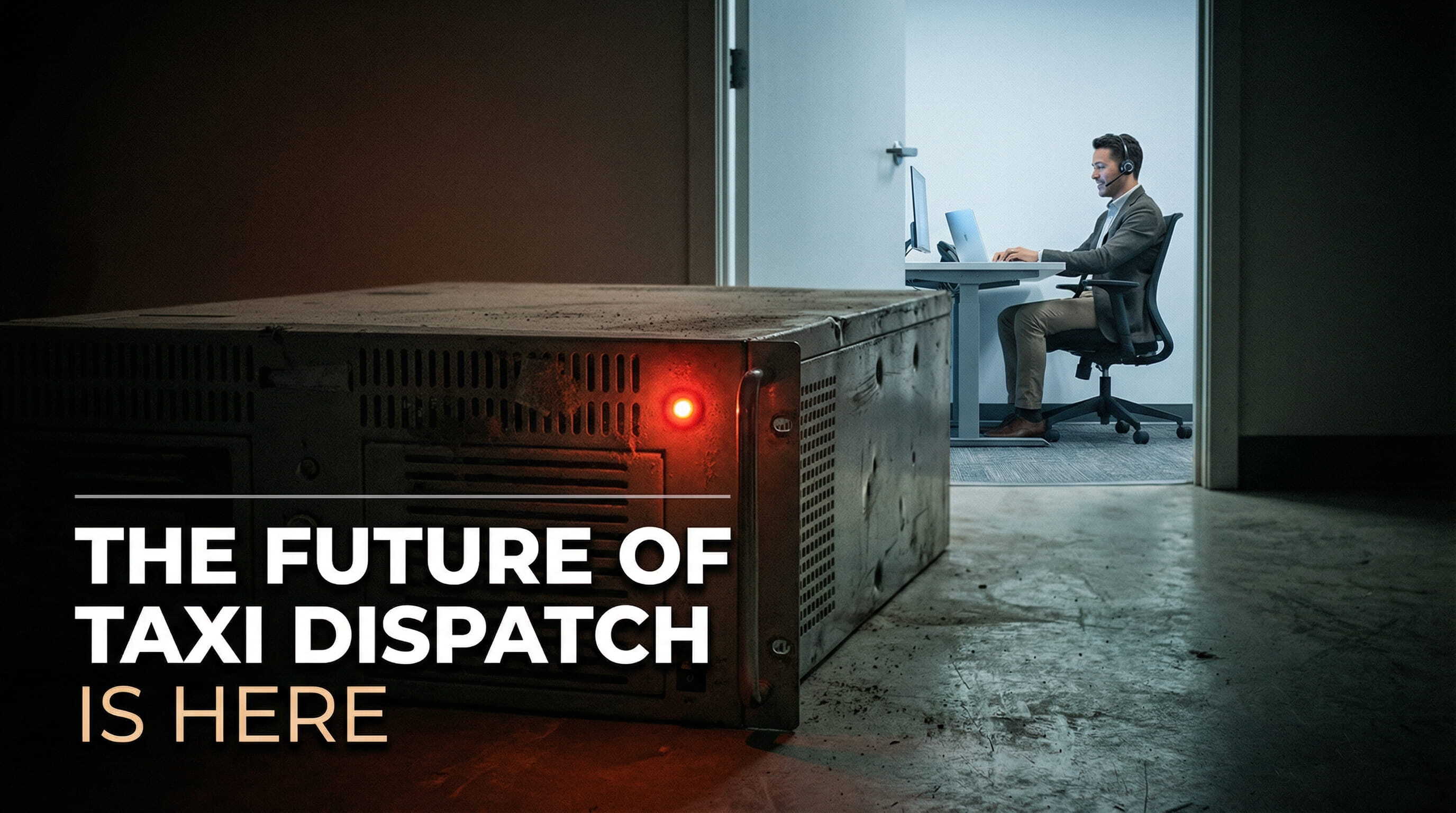
Ten years ago, every serious fleet operator had a server room in the back of the office.
That humming box was a badge of honor. You owned your tech. You controlled your data. You were the boss.
💡 Related Insight: Discover GPS vs. Cellular Tracking: Which is Best for Taxis? to optimize your operations.
Fast forward to today, and that same humming box is a ticking time bomb draining your bank account.
For broader market context, read the 2026 Taxi Dispatch Software & FHV Fleet Industry Report.
The Night Everything Went Dark
I remember talking to a fleet operator running 50 cars out of a cramped office in the UK.
He was proud of his local server setup. Five figures a year just for AC, electricity, and keeping the red lights from blinking. He thought he owned his technology.
He thought he was in control.
Then his server crashed on a Friday night during a massive downpour. Peak demand. The absolute worst possible time to go dark.
Hundreds of rides lost in three hours. Drivers blind. Passengers furious and calling competitors.
So we sat down the next week and ran the real numbers on his "reliable" physical setup. It wasn't just expensive. It was a massive single point of failure disguised as control.
The illusion of ownership was holding his business hostage.
He moved to a cloud taxi dispatch system the following month. Never looked back.
Within 90 days on cloud dispatch, his missed rides dropped from 12% to under 1%. His dispatchers could manage operations from their phones. His fuel costs stabilized. And that server room? He turned it into a break room for his drivers.
What Is a Cloud Taxi Dispatch System, Really?
Forget the jargon. Cloud simply means your dispatch platform lives on someone else's ultra-secure, massively powerful computers.
You access everything through a browser or an app. Anywhere. Anytime. Your dispatchers, your drivers, your reports. All in one place, accessible from any device with an internet connection.
Compare this to a traditional local server setup.
Local means you buy hardware upfront. You maintain it. You replace it every 3 to 5 years when it inevitably becomes obsolete. It is the equivalent of buying a power plant because you want to keep the lights on.
A cloud based taxi dispatch system requires a monthly subscription. You log in, and it works. If a server goes down in one data center, another one takes over instantly. You don't even notice the blip.
If your local server goes down, the entire office is screaming until your IT vendor decides to show up.
The difference is not about technology preferences. It is about speed and survival.
Cloud vs Local: The Head-to-Head Breakdown
Before we go deeper, let me lay the comparison bare. No spin. Just the facts that matter when you are running a real fleet.
| Factor | Local Server Dispatch | Cloud Taxi Dispatch |
|---|---|---|
| Upfront Cost | $5,000 to $25,000+ (hardware, licenses, setup) | $0 to $500 (subscription start) |
| Monthly Running Cost | $800 to $2,000+ (electricity, IT, cooling) | $100 to $500 (predictable subscription) |
| Uptime Guarantee | Depends on your IT guy's availability | 99.9%+ with automatic failover |
| Scaling | Buy new hardware, wait weeks | Click a button, scale in minutes |
| Remote Access | VPN headaches, limited | Any device, anywhere, instantly |
| Security | Padlock + basic firewall | Military-grade encryption, multi-region backups |
| Disaster Recovery | You lose everything if the office floods | Data mirrored across global data centers |
| Software Updates | Manual, expensive, disruptive | Automatic, seamless, zero downtime |
| Hardware Replacement | Every 3 to 5 years, your problem | Never. It is the provider's job |
The table tells the story. But let me dig into the three battlegrounds that matter most.
The Advantages You Cannot Ignore
Operational agility is the biggest advantage of going cloud.
You can scale server power up for the holiday rush and scale it back during slow months. Try returning a physical server because it is a quiet Tuesday in February. You can't. You bought it.
Your dispatchers are no longer chained to one desk in one room. Blizzard outside? They dispatch from their living room. A smart cloud dispatch system handles the routing while they focus on exceptions.
But the biggest advantage isn't for your dispatchers. It is for your drivers and passengers.
Drivers get a reliable app that doesn't crash every time they drive under a bridge. Passengers get what they expect in 2026: fast bookings, live vehicle tracking, automated ETAs, and instant driver ratings.
You get level-playing-field technology without hiring a Silicon Valley engineering team. The features that used to cost six figures to build are now available as a SaaS taxi dispatch platform for a fraction of the price.
That is the real advantage. Not just saving money. Gaining capabilities that were impossible on your old local setup.
The Real Cost Equation
Everyone fights about the cost. It is usually the biggest mental hurdle for traditional fleet owners.
So let me kill the confusion with math.
A legacy system looks cheaper over ten years if you only count the initial software license. But that is a trap. It is designed to keep you locked in while the hidden costs bleed you dry.
You have to factor in the hidden bleed.
Real Cost Comparison
5-Year Total Cost of Ownership: Cloud vs Local
Based on a 50-car fleet analysis
The cloud doesn't just save money. It eliminates entire cost categories that local servers force you to carry. (Based on industry averages from Hyvikk Solutions' client data across 200+ fleet migrations.)
Server depreciation over three years. IT consultant retainer. Electricity and cooling for the server room. Mandatory software update fees just to run on modern machines.
Now add the opportunity cost. How many rides are you losing because your system can't efficiently route cars during rush hour? How many corporate accounts are you missing because your reporting looks like a spreadsheet from 1998?
Compare all of that to the predictable flat monthly fee of a cloud taxi dispatch platform.
No surprise bills when a hard drive fries. No paying thousands for a compliance update. The cloud shifts your technology from a massive, unpredictable capital expense to a steady operational expense.
You stop paying for hardware and start paying for value. The math shuts down the argument every single time.
The Security Delusion
This is where fleet operators fool themselves the most.
"I want my data in my own building." I hear this constantly.
They think a locked door and a basic firewall means safety. It doesn't.
Your back office has a padlock and maybe a generic commercial alarm. Amazon Web Services has armed guards, biometric scanners, and billion-dollar security protocols. Google Cloud encrypts everything in transit and at rest by default.
Who do you think is better equipped to fight off a targeted ransomware attack? Your part-time IT consultant, or a dedicated team of thousands of elite cybersecurity engineers?
Cloud systems back up your data in real-time across multiple geographical locations. If your office floods, or burns down, your cloud taxi dispatch system literally does not care. Your dispatchers can log in from a coffee shop and keep the cars moving.
Your business survives disaster without breaking a sweat.
That is not marketing. That is architecture.
The Migration Framework
Knowing the cloud is better is one thing. Actually making the switch without destroying your operation is another.
Here is the framework I use when advising fleet operators on the transition.
- Step 1: Audit The Friction. Write down every pain point in your daily operation. Drivers hate your current app? Dispatchers fighting the interface? Don't just look for new software. Look for software that solves these specific, money-leaking problems. Start with understanding the real ROI of switching.
- Step 2: Run The Total Cost Model. Don't blindly compare the subscription to your old license fee. Map out the next five years. Include the hardware you won't buy, the IT hours you won't pay for, and the lost revenue from your current downtime. The numbers will speak for themselves.
- Step 3: The Phased Rollout. Do not shut off your old server and switch your entire fleet over on a Friday afternoon. That is business suicide. Start with a pilot group of 10 to 15 of your most tech-savvy drivers. Find the breaking points before your customers notice a thing.
- Step 4: Train, Then Trust. Spend one week training dispatchers on the new cloud dashboard. Let them run both systems in parallel. Once they stop reaching for the old screen, you know the migration is working.
The Reality Check
Here is the truth nobody selling dispatch software wants to tell you.
Migrating to the cloud will be a nightmare for the first two weeks.
Your dispatchers will complain loudly. They know the old system's shortcuts and they hate change. Your older drivers will tell you the old way was faster.
Things will break. Custom workflows will fail. You will stare at your screen during a chaotic Tuesday rush and question everything.
But push through it.
The learning curve is brutal but temporary. The operational leverage you gain is permanent.
If you stay local because it is comfortable, you are choosing a slow death by inefficiency. And your competitors who already moved to the cloud? They are not slowing down to wait for you.
When Cloud Might NOT Be Right (Yet)
I am going to be honest here because I believe in giving you the full picture, not just the sales pitch.
There are edge cases where a taxi dispatch cloud migration might not be the right move today.
- Extremely remote areas with no reliable internet. If your fleet operates primarily in an area where mobile data coverage is spotty and there is no fixed broadband, a cloud based fleet dispatch system depends on connectivity that you simply don't have yet. Wait until Starlink or 5G coverage reaches your zone.
- Regulatory lock-in. Some government contracts in specific countries mandate that all data must be stored on physical servers within the country on-premises, not in a cloud region. If you serve those contracts, check your compliance requirements first.
- You are 6 months from retirement. If you are planning to sell the fleet and exit the industry, the ROI window on a cloud migration might not close in time. The investment pays off over 12 to 24 months. If you are not going to be around to see it, don't force the switch.
For everyone else? The math is overwhelmingly in the cloud's favor. These are the exceptions, not the rule.
Cloud Dispatch and AI: What Is Coming Next
Moving to the cloud is not the final destination. It is the launchpad.
The next wave of competitive advantage in the taxi industry is AI-powered dispatch intelligence, and it runs exclusively on cloud infrastructure. You cannot run these workloads on a box under your desk.
Here is what the next 12 to 24 months look like for cloud-first fleets.
None of this is science fiction. These capabilities exist today in platforms built for cloud-native operations. The fleets adopting them now will be untouchable in two years.
The question is not whether AI will reshape taxi dispatching. It already is. The question is whether your infrastructure is ready to take advantage of it. If you are on a local server, the answer is a hard no.
Frequently Asked Questions
Can a cloud taxi dispatch system work if my office internet goes down?
Yes. Your dispatchers can immediately switch to mobile hotspots or log in from a smartphone. The cloud dispatch system keeps running on remote servers. You never lose a single booking or GPS signal from your drivers.
Is a cloud based taxi dispatch system actually cheaper than buying my own servers?
When you factor in electricity, physical cooling, IT maintenance fees, hardware replacement every 3-5 years, and lost revenue from downtime, the cloud subscription is significantly cheaper. You pay for what you use, not for idle server capacity sitting in a back room.
How long does it take to migrate a 50-car fleet to the cloud?
Setting up the cloud instance takes hours. The real migration including training drivers, configuring your pricing zones, and transitioning dispatchers should be done in phases over 2 to 4 weeks to avoid operational chaos.
Is my fleet data safe on a cloud dispatch platform?
Cloud platforms like AWS and Google Cloud use military-grade encryption, multi-region backups, and dedicated cybersecurity teams. Your data is safer on their infrastructure than on a local server protected by a padlock and a part-time IT consultant.
Can I run cloud and local dispatch systems simultaneously during migration?
Yes. Most operators run both in parallel during a phased rollout. Start with a pilot group of 10-15 drivers on the cloud system while the rest stay on your legacy setup. Once the cloud workflows are proven, migrate the rest gradually.
The Bottom Line
The taxi business is not about owning cars anymore. It is about owning the most efficient logistics network in your city.
A cloud taxi dispatch system gives you the tech infrastructure of a massive global platform for a few hundred dollars a month. That is the only way you can legitimately compete with the deep-pocketed apps trying to erase you from the map.
Every month you stay on a local server, you are paying a premium to be less competitive.
It is not about if you move to the cloud. It is purely a question of when.
Recommended Next Read: What is Telematics in Fleet Management?
I've built the models and seen the migrations up close. We can lay out the real numbers for your operation. Drop me a message and we'll see if the math makes sense for you right now. No hard sell. Just honest logistics.
Get My Free Cloud Migration Plan