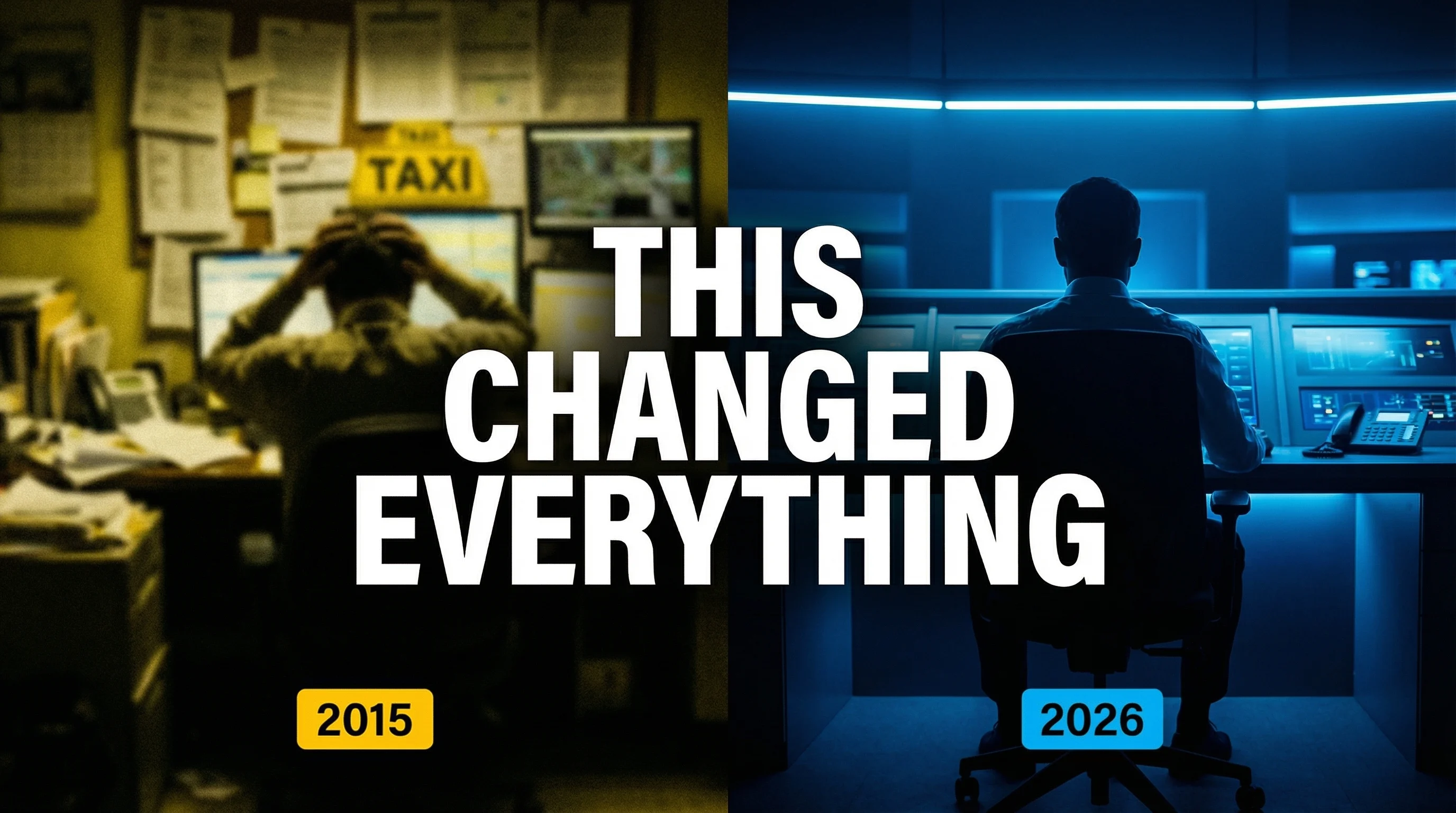
Remember 2015?
You waved your hand in the air like you were drowning, hoping a yellow car would stop. Need a ride in the rain? You got wet. Need a ride at 2 AM? You walked home. If the driver didn't like your destination, he just kept driving.
Fast forward to 2026.
If I want a ride today, I press a button on a piece of glass. Three minutes later, a car pulls up. The driver knows my name. I know his rating. Payment happens invisibly. I don't even need to open my wallet.
💡 Related Insight: Discover What is Telematics in Fleet Management? to optimize your operations.
It feels like magic. But at Hyvikk Solutions, we know magic is just engineering disguised as user experience.
Behind that "Request Ride" button is a massive, complex engine processing 1,000 requests per second. That engine is taxi dispatch–the software that powers modern ride-hailing.
If you are trying to build a fleet business today without understanding how this engine works, you aren't building a business. You are just owning cars. And owning cars is a liability. Owning the network is the asset.
This guide explains the operating workflow. Once you understand the system, use our taxi dispatch software feature checklist to assess requirements, our pricing guide for costs, or our platform comparison to compare vendors.
Let's tear it down and look at the engine block.
For broader market context, read the 2026 Taxi Dispatch Software & FHV Fleet Industry Report.
The Dead Era of Radios: Why the Taxi Radio Dispatch System Lost
Six years ago, I walked into a traditional taxi dispatch center in Mumbai. It was absolute chaos.
Phones were ringing off the hook. Guys were shouting cryptic codes into radios. "Unit 45, go to Bandra!" "No, Unit 47 is closer!" "Unit 12, where are you? The customer is screaming!"
It was human-dependent, slow, and unscalable.
- Single Point of Failure: If that dispatcher got sick, the fleet slowed down.
- Bottleneck: If the phone lines jammed, money burned.
- Lack of Trust: If a driver lied about his location, you couldn't prove it.
Today, modern dispatch software replaces that entire room of screaming people with silence.
Silence is scale.
When software makes the decisions, you don't need a bigger office to add 500 cars. You just need more server capacity. You move from "managing people" to "managing exceptions."
If you are still running your transport business on WhatsApp groups and phone calls, you are already dead. You just haven't fallen over yet. If cost is what is holding you back, see which free taxi dispatch software options are actually usable first.
What Actually Is It? (The Breakdown)
Don't overcomplicate it with buzzwords. A taxi dispatch system is simply matchmaking infrastructure–software that connects riders with drivers.
It connects Demand (Passenger) with Supply (Driver) using Logic (Dispatch Algorithm), while the Admin Panel (God Mode) watches everything.
It’s not just "an app." It’s a three-headed beast, and each head needs to serve a specific purpose.
If you buy a cheap "taxi app" script, you usually get a pretty passenger app but a broken backend. Here is what a real, investable system looks like:
The Demand Magnet
1. The Passenger AppThis is the tip of the iceberg. It's 10% of the tech, but 100% of the brand. Learn more about our Customer App.
The Supply Command
2. The Driver AppThis is where the money is made. If drivers hate your app, they won't drive. See our Driver App in action.
God Mode
3. The Admin PanelThis is where YOU live. It’s not just a map with moving dots; it is your command center. Check out our Admin Panel.
- CFO Role: "Which driver brings the most revenue?"
- HR Role: "Who is cancelling too many rides?"
- Ops Role: "Why is downtime spiking in Zone B?"
The Brain: Dispatch Logic
This is where 99% of people fail. They think a taxi dispatch program just needs to "find the nearest driver."
That is wrong.
Let's play out a simple scenario:
Control comparison
What changes when every branch uses one system
Customer A requests a ride.
Driver B is 1km away. System pings Driver B.
Driver B is eating lunch. He ignores it.
...15 seconds pass...
System pings Driver C (2km away).
Driver C is fueling. He rejects it.
...15 seconds pass...
Customer A has now waited 30 seconds staring at "Finding driver..."
Customer A cancels.
You lost revenue. You lost trust.
Smart dispatch in 2026 uses Logic Layers:
Blast to all drivers within 2km for the fastest pickup possible.
Group multiple requests to optimize driver routes and reduce wait times.
Prioritize drivers who have been waiting the longest to ensure fairness.
Move drivers to where demand will be. "Head downtown, the concert ends in 15 mins."
If your software does not have configurable dispatch logic, you are bringing a knife to a gunfight.
The Hard Truth
I see founders try to build this from scratch constantly.
"I'll hire two developers. We'll launch in 3 months."
No, you won't.
Here is your realistic timeline if you build it yourself:
The Game Over Scenario: You buy a "white label clone" that looks like Uber. You launch. Friday night comes, demand spikes, and the server crashes. Drivers can't end trips, passengers get charged double, and data leaks.
In this game, uptime is trust. If your software breaks, your brand breaks.
Build the Asset, Not the App
Fleet management isn't about cars anymore; it's about data. Who moves where? At what price? At what time? Which routes are profitable? Which drivers are stealing fuel?
Whether you run a small fleet or manage hundreds of vehicles, taxi dispatch software that captures this data is your competitive advantage.
Taxi dispatch software is the tool that mines this data for you.
Stop looking for a "clone script." Start looking for a taxi operating system–software that runs your entire fleet, not just dispatches rides.
You need a partner that understands the chaos of the streets but delivers the silence of the server room. You need a system that grows when you grow.
That is what we built at FleetFlow.
We didn't just build an app. We built the infrastructure for scale: automated dispatch, predictive analytics, and rock-solid stability.
Frequently Asked Questions
Does FleetFlow support custom branding?
Yes. We offer a full white-label text. You get your own branded Passenger App, Driver App, and Admin Panel with your logo and colors.
How long does it take to launch?
Unlike custom development which takes months, FleetFlow can be deployed in just 5-7 days.
Do I need technical knowledge to manage the software?
No. Our Admin Panel is designed for business owners, not developers. It's intuitive and easy to use.
Is the source code included?
We offer different plans. Our Enterprise plan includes options for source code ownership. Contact sales for details.
Where to Go Next in the Taxi Dispatch Software Series
Now that you know what taxi dispatch software is, here is where to go deeper depending on where your fleet is today.
- Comparing vendors? Start with our best taxi dispatch software roundup of the top systems on price and ROI.
- Running 10 to 50 vehicles? Read Best Taxi Dispatch Software for Small Fleets.
- Scaling 50 to 200 vehicles? See the Mid-Sized Fleet Software Guide.
- Minicab or PHV operator in the UK, US, or UAE? See Best Taxi Software for Minicab Companies.
- Working out a budget? Read Taxi Dispatch Software Pricing.
- Building a buying checklist? See the 15 essential taxi dispatch app features.
Recommended Next Read: What is Telematics in Fleet Management?